Why your park and your seasonals shouldn’t share an insurance company
A Signature Park advisory for Canadian campground and RV-park owners.
It sounds efficient. Your insurer offers to cover your park’s commercial property and also sell coverage to your seasonal campers. One relationship, one renewal, one phone call. Some parks even like the idea of a “park program” for seasonals because it seems to make certificate tracking easier.
But insurance is tested on the worst day, not the easiest one. When something goes wrong on a seasonal site, having the same company on both sides of the claim can quietly work against you. Here are the pitfalls every campground owner should understand before saying yes.
-
When a fire starts on a seasonal site
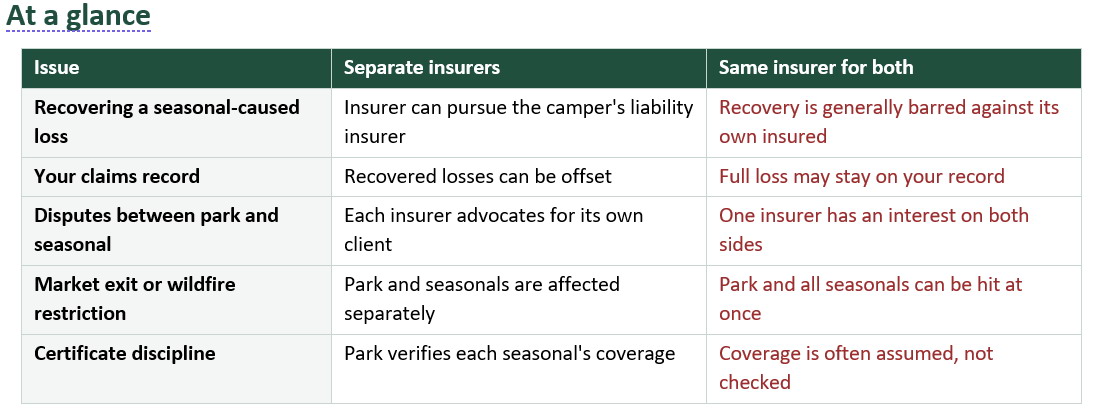
Picture a seasonal trailer catching fire late on a July evening. The flames spread to your clubhouse, melt a row of hydro pedestals and damage two neighbouring units. Normally, your property insurer pays your claim and then pursues the at-fault camper’s liability insurer to recover what it paid. That process is called subrogation, and it is how the cost of a loss ends up with the party who caused it.
Canadian courts have long held that an insurer cannot subrogate against its own insured. In Lacombe v. Don Phillips Heating, an Ontario court applied that rule even where the two parties held separate policies with the same insurance company. If one insurer covers both you and the camper, there may be no one to recover from.
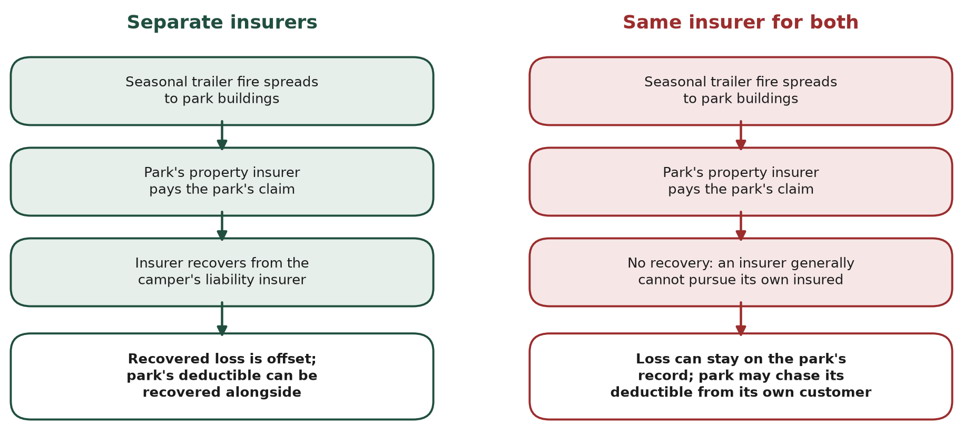
Figure 1. How a seasonal fire claim can play out. Illustrative only; outcomes depend on policy wording and facts.
The practical result: the full loss can sit on your park’s claims record and influence your next renewal. Your deductible, and any uninsured losses such as lost site fees beyond your limits, would normally be recovered alongside the insurer’s claim. Without that recovery, you may be left chasing those dollars from your own customer, the person you want back next season.
-
A conflict built into every claim
When a guest trips over a seasonal’s deck, or a child is hurt near a unit, the park and the camper often point at each other. Was it the park’s lighting and pathways, or the seasonal’s poorly built steps?
If the same insurer stands behind both of you, its financial interest is to keep the combined payout as low as possible, not to argue hard for either side. Courts in other jurisdictions have described this as an insurer having an interest in effecting a balance between the litigants. You deserve an insurer whose only interest in that claim is yours.
Ask yourself
If my Park and a Seasonal Renter end up blaming each other, who is my insurer really working for?
-
All your eggs in one basket
Concentration cuts both ways. If that insurer reduces its appetite for campgrounds, tightens wildfire underwriting or exits the class altogether, your property policy and your seasonals’ coverage can disappear at the same renewal. Your seasonals then call you, not the insurer, looking for answers.
A single wildfire, windstorm or flood that sweeps through the park also becomes one large accumulation of losses for one company: your buildings, your liability and dozens of seasonal units at once. That kind of concentration invites higher deductibles, sub-limits and restrictions for everyone in the program.
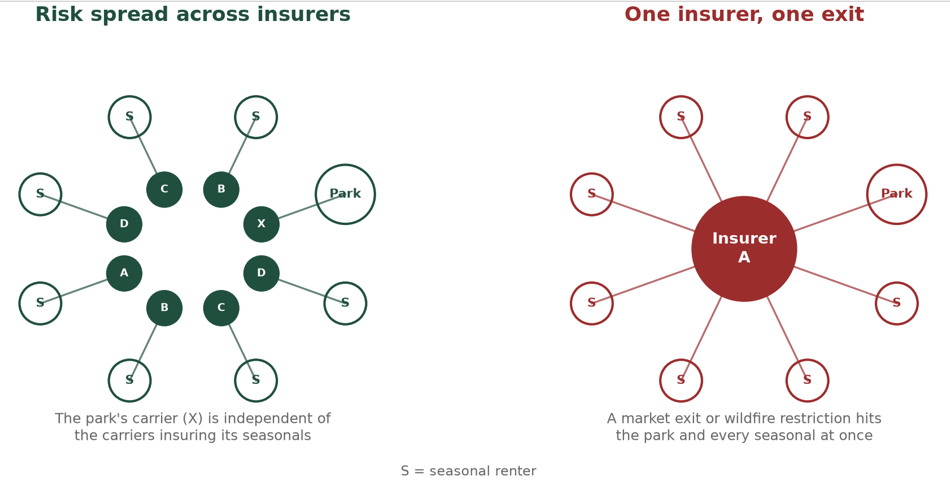
Figure 2. Spreading risk across independent insurers versus concentrating the park and its seasonals with one company.
-
Convenience breeds complacency
Parks that bundle seasonal coverage often stop checking the details. Are the seasonals’ liability limits adequate? Is the park named as an additional insured? Do certificates match the units actually on site, including decks, sheds and golf carts? Assumed coverage is not verified coverage.
What Signature Park recommends
- Keep your commercial property and liability with a carrier that does not insure your seasonal renters.
- Require every seasonal to carry their own liability coverage, with the park named as an additional insured, and verify certificates every season.
- Review your seasonal agreement with your broker so responsibilities for fire, damage, injury and hold-harmless obligations are clear.
- Set minimum liability limits for seasonals and match certificates to what is actually on each site.
- Revisit your program at each renewal, especially your wildfire exposure and accumulation of values in one area of the park.
Four questions for your Insurance Broker
- Does my insurer also cover any of my seasonals?
- If a seasonal causes a loss, can my insurer recover from them?
- Who would control the defence if the park and a seasonal blame each other?
• What happens to my park and my seasonals if this insurer exits the campground market?
A second opinion, at no cost
Signature Park is 100% independent and Proudly Canadian, with decisions made in Canada by Canadians. Our only interest is protecting your park. If you would like a fresh look at how your program is structured, ask your insurance broker about a free, no-obligation review from Signature Park.
This article is general information, not legal advice. Coverage depends on your policy wording, your seasonal agreements and the facts of each loss.
To request a free, no obligation quote, please contact your insurance broker or visit: www.signaturerisk.com/park.
Peter Lovering
Business Development Specialist
Signature Risk Partners Inc.
437-703-2507
(800) 260-9921 x 129
www.signaturerisk.com
plovering@signaturerisk.com
Sources: Harper Grey, summary of Lacombe v. Don Phillips Heating Ltd. (Ont. S.C.J.), https://www.harpergrey.com/uncategorized/lacombe-v-don-don-phillips-heating-ltd-2005-o-j-no-3936-ontario-superior-court-of-justice/ ; Pink Larkin, “Subrogation: When Insurers and Insureds Collide,” https://www.pinklarkin.com/updates/news-item/subrogation–when-insurers-and-insureds-collide ; O’Morrow v. Borad (Cal. 1946), https://supreme.justia.com/cases/california/supreme-court/2d/27/794.html