A Special Feature by Jason Livengood
A friend in the publishing industry came to me with some alarming numbers. His traffic to his website had dropped 25-35% on average from the year before. That’s over a quarter of his traffic to his main website! He averaged millions of visits a month. And then bam! 25% of that just gone.
There was no change in quality. No Google penalties. No technical issues with the site. The articles were still well written and his SEO fundamentals were still solid. The visits just weren’t there anymore.
The culprit?
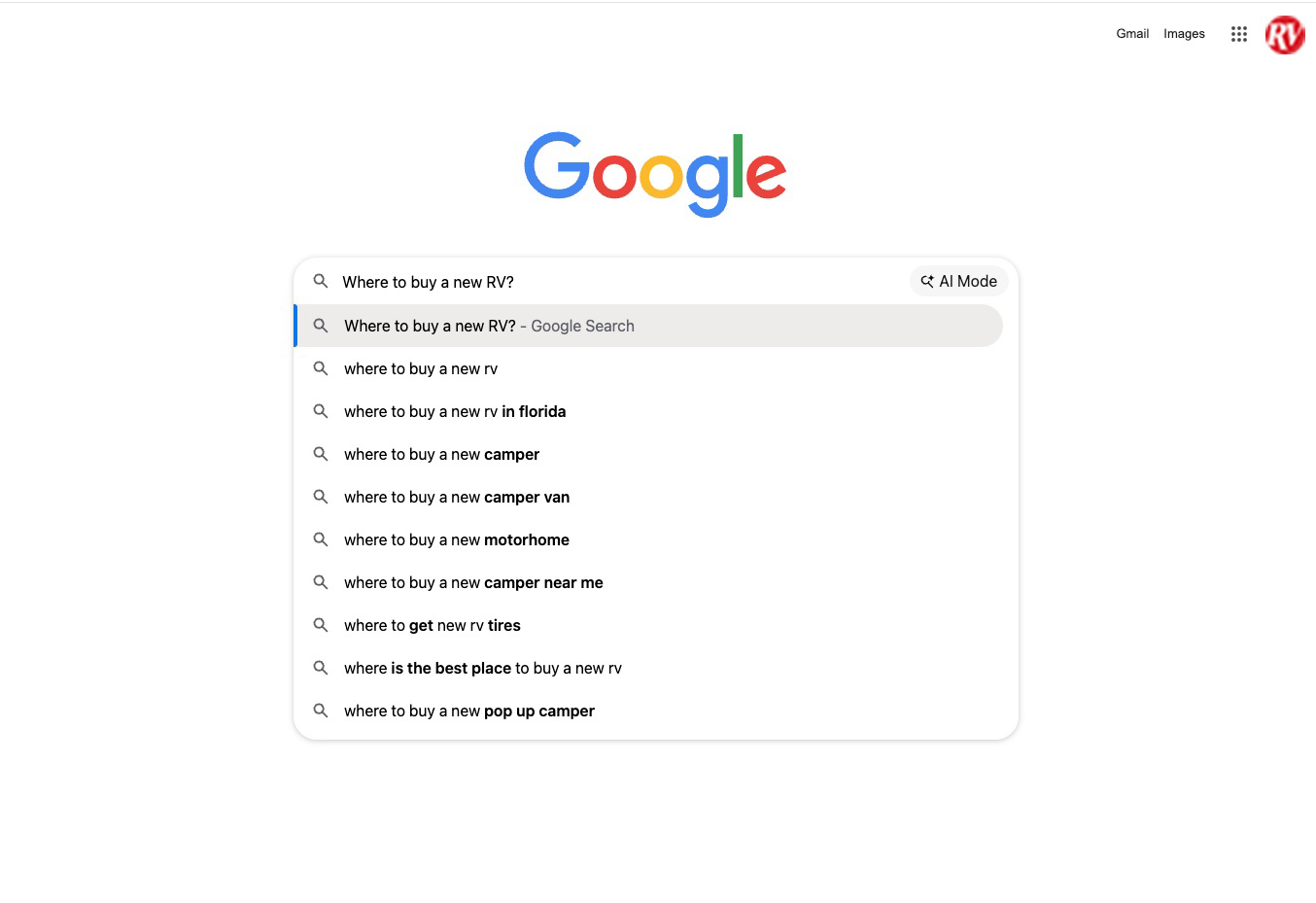
Google. They’ve quietly flipped a switch on how search works. Its new “AI Overviews” now appear at the top of search results across the U.S.. Ask something like “best travel trailers for families” or “how to winterize an RV”, and instead of a list of websites…
You get an AI-generated answer instantly. The question gets answered before a single website has ever had a chance to earn a visit. .
Think about what that means. For the first time in its history, Google is positioning itself not just as a gateway to the internet, but as the final destination..
If that makes you uneasy, it should. But before we jump to conclusions, let’s look at the actual numbers.
Even now, Google still controls 89-90% of global search. But that’s down from the 91%+ dominance it maintained for years.
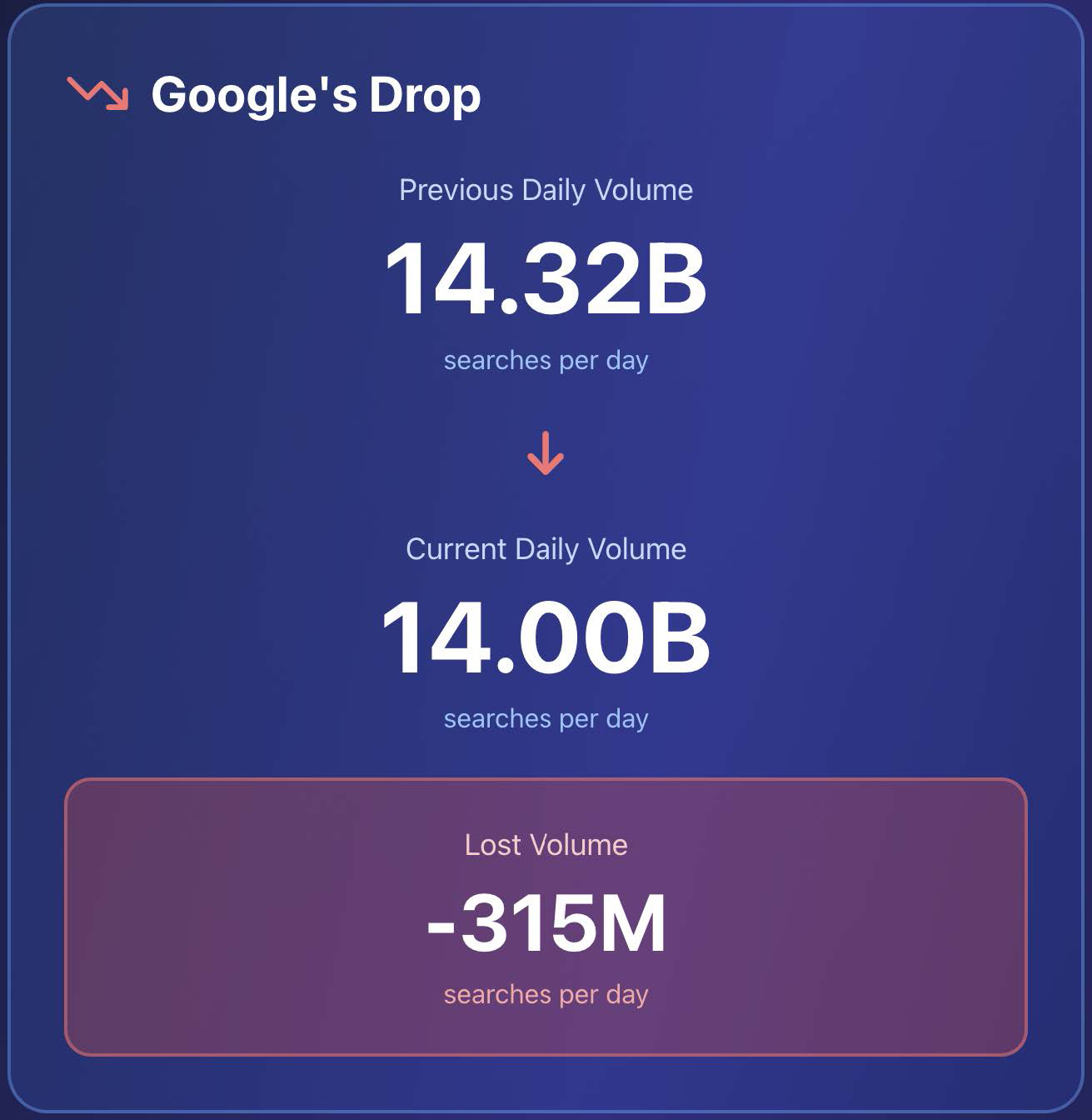
Let’s zoom out and look at the current landscape. Google processed more than over 5 trillion searches in 2024–roughly 14 billion per day.In fact, total search volume grew over20% last year. So in raw numbers, search isn’t dying. But attention is fragmenting. For the first time since 2015, Google’s global market share slipped below 90%. A drop from 91% to 89% may sound small, but that 2% shift represents roughly 315 million searches per day moving elsewhere. That’s 115 billion searches per year–more than many search engines have processed in their entire existence!
So where did they go?
The traffic is flowing into AI answer engines like ChatGPT, Perplexity AI, and others…
Alternative search engines gaining incremental share….
And entirely new forms of search behavior that didn’t exist a few years ago.
A 2% shift doesn’t sound dramatic. But in search economics, that’s enough demand to sustain multiple billion-dollar companies.
 WHAT THIS MEANS FOR PUBLISHERS
Those are large numbers no doubt. But what does that mean for the rest of us? My publishing friend is one example. He quotes a 25-35% loss. That’s devastating if you rely on ad revenue.
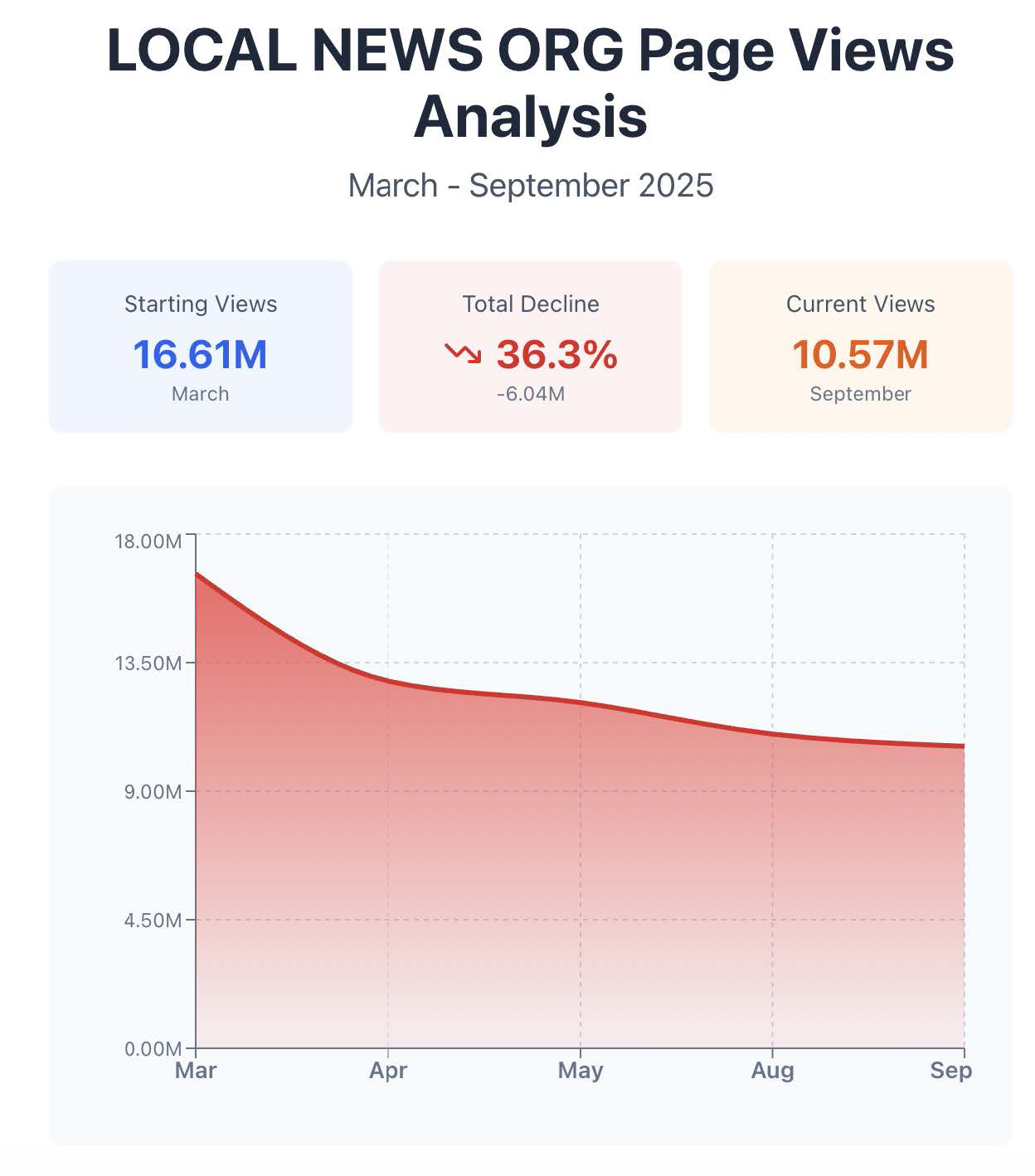
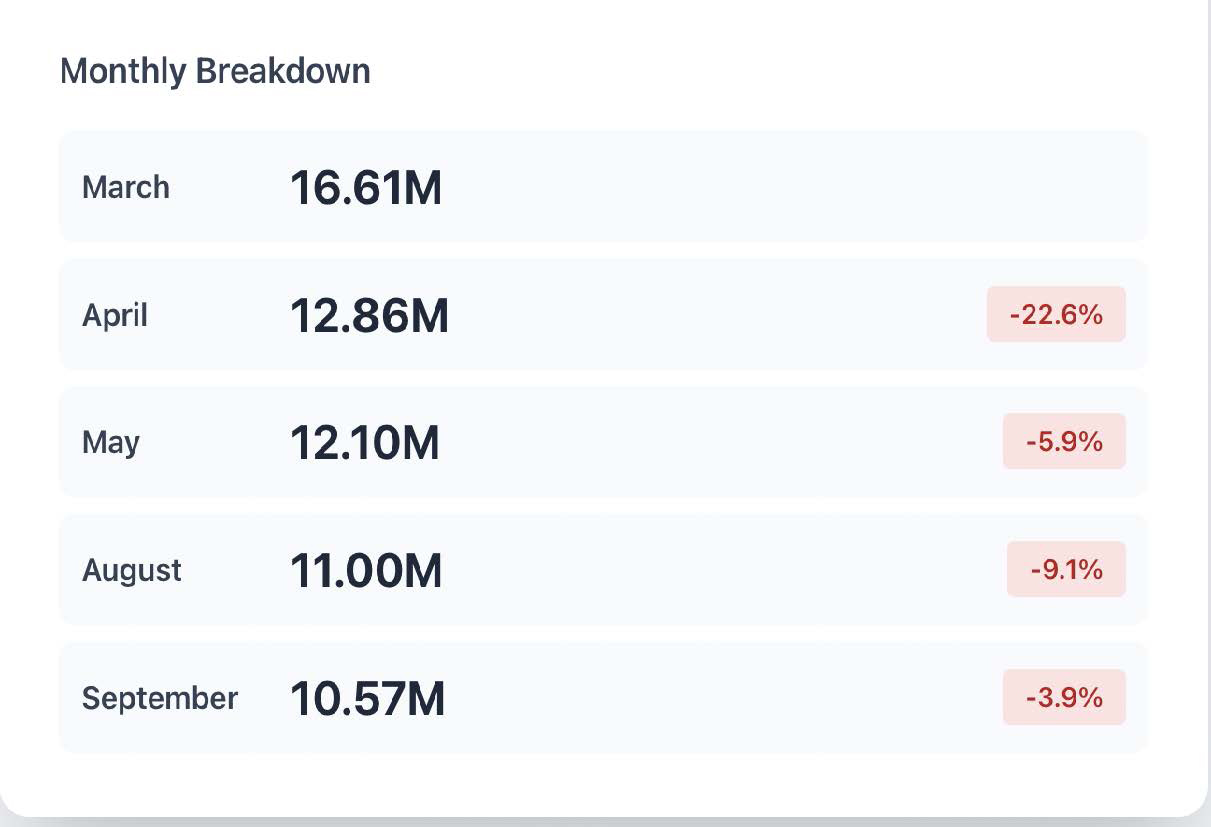
Let’s take another example where it hits close to home for me. I work with a local news organization that is the only major news source in its market. They have been around for 80 years. Deep brand recognition. Strong trust from the community. The kind of outlet you’d assume is insulated from Internet shifts. . If anyone should have been immune from traffic disruption, it was them. What would you think happened to my local news org? I would have said nothing. Or minimal. People in this community would have the website bookmarked and their apps already downloaded so any loss would be rather small.
But look at the data: (this slide is better.)
 Some of you might be thinking, “OK, but that’s just publishing, right? News sites and lifestyle blogs are one thing. What about our industry—the auto and RV world?”
Fair question. And here’s the truth: we’re not immune, but we’re not getting crushed either. At least not yet.
Here’s what’s actually happening: Dealer website traffic has stayed surprisingly stable—actually up 2.5% in 2025. That sounds great until you realize predictions said it would drop by 60%. So we dodged a bullet, but we’re still in the crossfire.
And it gets weird. AI is playing both sides. In some cases, it’s actually sending traffic to dealers—people using ChatGPT or Perplexity to compare models, then clicking through to dealership sites. That AI-driven traffic jumped 43% in September alone.
But here’s the catch: AI is also stealing traffic at the same time. When someone searches “best SUVs 2025,” Google’s AI Overview just answers the question right there. No click-through. No website visit. No lead.
And that’s hitting where it hurts—the cost per lead is climbing. Right now it’s averaging $283 per lead and going up.
The manufacturing sector overall (which includes auto and RV) is down about 4% this year. I know, I know—4% doesn’t sound catastrophic compared to the 25% drops we talked about earlier. But think about it: when was the last time you or your boss were OK with any loss? When has “we’re only down 4%” ever been a winning pitch in a board meeting? Yeah, me neither.
And just for context: travel and tourism went from 34.7% growth to being down 1.6%. Finance dropped from 13.1% growth to down 1.4%. Fashion, DIY, and cooking sites? Down as much as 70%. Some B2B companies lost 73% of their traffic.
Auto dealers at 3.8% down? We’re getting off easy compared to other industries—10% to 30% less impact. But “less bad” isn’t exactly a strategy.
And AI isn’t done. Not even close.
They’re coming for e-commerce next. Walmart, Shopify, and PayPal just inked deals with OpenAI to let people buy products directly inside the chat interface. No redirect to a website. No checkout page. Just “I want that blue jacket in medium” and boom—purchased through ChatGPT.
So here’s my question: How long before someone asks Claude, “Find me the best financing for a used Class C motorhome under $80K,” and the AI doesn’t just recommend options—it completes the loan application right there in the chat?
The last 20 years of search and SEO? It’s not dead, but it’s evolving fast. The people who adapt now—who learn how to work with AI instead of against it—are the ones who’ll own the next decade.
So here’s how you stop the bleeding and maybe even get ahead of this thing:
STOP THE BLEEDING
Full transparency: I work in broadcast advertising. Yes, paid marketing can help stop the bleeding. But most of what I’m about to share is either free or low-cost—and you can implement it yourself.
Paid ads can offset lost organic visitors, , and that’s part of what I do professionally,so I want to be upfront about that.
But this isn’t just about plugging holes.
These strategies are about positioning your business to be found and recommended by AI, not just by traditional search.
You’ll hear this called GEO ( Generative Engine Optimization) or AEO (Answer Engine Optimization).
This is the new game that needs to be won. And the businesses that learn it first will have the advantage.
How it works:
1. STRENGTHEN YOUR FOUNDATION. Your website still needs strong SEO fundamentals. Traditional SEO is your base layer. Think of GEO/AEO as the new structure built on top of that foundation. .
That also means optimizing your Google Business Profile.. It really can move the needle and there are some proven tactics that can be applied.
Your SEO strategy should work together with your Google Business Profile and your presenceYoutube. Remember, Google owns both—and Google tends to recommend its own ecosystem.
That’s why starting the Youtube channel you’ve been putting off is a smart move. A simple video like “How to winterize an RV” is a great start and could be recommended by Google’s AI summary.
2. BUILD LOCAL & AUTHORITY-DRIVEN CONTENT. Create in-depth resources for your website–research guides, blog articles, and FAQ’s–that do more than target keywords. Your goal is to demonstrate clear expertise in your field as well as your local reach.
When your website consistently provides deeper, more comprehensive information on a topic than competing sites, AI systems are more likely to recognize you as an authority and surface your content when users ask related questions.
Develop focused content hubs: publish multiple articles on related topics, using local search terms and turn them into dedicated pages, and link them together strategically. (Look into ‘Inner Hidden Pages’ or ‘SEO Silo’s’ to help you with this.)
Recently, a Subaru dealership in Oklahoma used a similar strategy and saw website traffic increase 78%.
Pro tip: Use AI to help you do this. Help you. Not do it FOR you. Don’t copy and paste. AI recognizes AI.
3. USE STRUCTURED DATA AND SCHEMA MARKUP. Here is a big one that is too often overlooked: Use structured data and schema markups on the code of your website so that AI can understand what your website is trying to convey.
Schema markup is like putting labels on everything in your website so computers can easily understand what each piece is. You can tag things like “this is a question and answer,” “this is a review,” “this is our address,” or “this is a how-to guide.” When you add these labels, AI tools can quickly find and understand your information, which makes them more likely to recommend your site to people.
4. SHOW UP WHERE CREDILITY ALREADY EXISTS. This part isn’t new. It’s the modern version of what used to be called “backlinking.” But it has just become more important than ever.
In other words, make sure your business is listed accurately on the right platforms and directories. Places like Yelp, Yahoo Business, Bing Places, Apple Maps and more specifically to the auto industry Edmunds or DealerRater.
This is only the tip of the iceberg and there is more to do but the above suggestions are the best place to start. By implementing these changes you will put yourself ahead of most competitors. Some lost organic traffic may not come back. That’s the reality. But you can stop the bleeding and be one of the first to the new game called GEO.
If you’d like to go deeper on the topic, follow the active influencers in this space. Start with reading some great blogs by Jeremy Ashburn at PushLeads. Chris Donnely has long been preaching GEO and he has great content on his LinkedIn page. He has also started a new company called Searchable that aims to help businesses get found and recommended by AI.
And if you’re unsure where your site stands, I’m happy to take a look and give you straightforward feedback on your SEO/GEO readiness.

Jason Livengood is a Sales and Marketing Consultant with WLOS News 13, a broadcast station owned by Sinclair Inc. Previously, he worked as an Account Executive at Apple and Intuit, specializing in SMB and Mid-Market companies. He also leads LivAMP, a personal project focused on bringing transparency and truth to marketing and sales. You can connect with him
at www.livamp.org or on Instagram(@livvampp or https://www.instagram.com/livvampp/ , Linkedin at https://www.linkedin.com/in/jason-livengood/ or via email at jlivengood@sbgtv.com.